Wednesday, February 16, 2011

A picture is worth a thousand words.

I think one of the most important points in my research is that the evidence clearly shows that it is a photograph of a person and not of a painting. Here are just a few basic reasons that lead me to this conclusion.

1. Depth of field. In optics, particularly as it relates to film and photography, depth of field (DOF) is the distance between the nearest and farthest objects in a scene that appear acceptably sharp in an image. Although a lens can precisely focus at only one distance at a time, the decrease in sharpness is gradual on each side of the focused distance, so that within the DOF, the unsharpness is imperceptible under normal viewing conditions.

In some cases, it may be desirable to have the entire image sharp, and a large DOF is appropriate. In other cases, a small DOF may be more effective, emphasizing the subject while de-emphasizing the foreground and background. In cinematography, a large DOF is often called deep focus, and a small DOF is often called shallow focus. Thanks, Wikipedia, for your quick definition.

In the case of the Joseph Smith photo, there is a shallow depth of field. His eyes and face are in focus and quickly graduate out of focus in the foreground and background. Only a 3D object could create this.


I have a link to a great website that shows early daguerreotypes that had these same focusing issues as well as giving a great little history lesson about daguerreotype photography. Here's the link.

2. Reflection. Daguerreotype photographs are a mirrored, polished surface that must be tilted slightly in order to view the image. Photographing a daguerreotype becomes even more tricky, especially before 1879. Through my various research, I believe that in fact that my photo as well as the two Library of Congress photos of Joseph all have the same embedded reflection.

Please note that the following image has had the contrast enhanced to show the details of the reflection. While it can be seen with the naked eye on the original it does make it easier for the viewer to screen it via the internet.


Click on image to enlarge.

Note the various 45-degree angles as well as parallel lines. I highly doubt that scratches/defects would happen randomly in this manner and so repetitively. I did originally believe that this was just a defect of my photo as well as the Library of Congress images. At the time, I did not understand the difficulty in photographing daguerreotypes. Back to the whole photo of the RLDS painting argument, why would Joseph Smith III continually reproduce this image with this defect? Unless perhaps it was the best one they came up with. I have seen the negative of the RLDS painting from the late 1800's, and it did not have this brick-like pattern weaved across it. Nevertheless, truly this argument ended for me a while back when I realized my image had many hidden details that painting did not possess. (Read about it a couple of pages back :D)
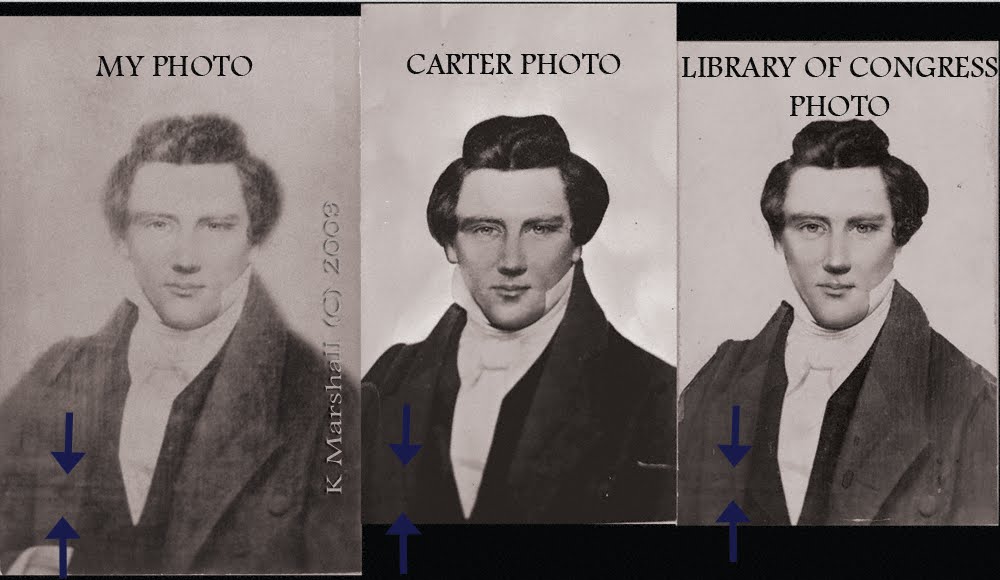


I must revise what I stated earlier about the Carter image being different from the Library of Congress image. Two images were, in fact, submitted to the Library of Congress by Joseph Smith III in 1879. It is my belief that William Carson was the re-photographer of all three images because of the uniqueness of the reflection. It is possible that more than one negative was used at the time, but if my theory is correct, Carson's negative would have been the source for all three images. The Carter image and the Library of Congress image being edited and rephotographed then submitted for copyright.


Monday, August 2, 2010

Update... well kind of.


I have recently been receiving inquiries about the size of the photo and any more information regarding its origin. I have been super busy with my family and have been meaning to give a few updates but will have to postpone that part for a later blog. However, I'm posting a higher-resolution picture for my blog. Enjoy!

Saturday, April 3, 2010

Photo and Death Mask

Joseph Smith photo superimposed over death mask.


Original photo of death mask.

Thursday, March 18, 2010

Grandma's journals.

I spent a good part of last fall and winter reading through my maternal grandmother’s journals. She loved to write, and keeping a journal was perhaps one of the great passions of her life. I enjoyed getting to see an inside perspective of her time on this earth, and I definitely feel like I know her better, but ultimately my agenda was to find more information about the Joseph Smith photo she passed on to me.

I must say that in regard to the photograph, she spoke only a few times, and her references were the same. She spoke of it being copied off the original tintype of Joseph. In all fairness, she would not have known the difference between a tintype and a daguerreotype photo, so the meaning is the same to me. At one point in the early 1990’s she wrote of her new husband, an amateur artist, working on a painting from the photo. They were serving a couple’s mission in California at the time, and during that time she passed out photocopied images of his artwork, as well as photocopies of her scrapbook page that included news clippings and the small unedited Joseph Smith photo.

As for the painting done by her husband, it was passed onto his family after his death and while I remember seeing the painting, I can only find a picture of it in the background of a photo of them from around 2002.

I was really hoping that I would find information in her journals from her first mission in Texas in the late 1960’s, but there are blocks of time missing, and I know that some of her precious journals were unfortunately damaged and disposed of due to extensive moisture and mold a couple of years ago. I have found a couple of leads to investigate, and I still need to follow them through, as well as develop a couple of possible theories, but nothing has been resolved in that regard.

So what’s happening now? We are hoping to do sort of a roundtable with various experts in the field as well as representatives from the LDS Church. This has been in the making for the last eight months, but schedules have been busy, and who really wants to head to Salt Lake in the wintertime. LOL. There has been talk about possibly doing it in a couple of weeks, but we will see if things can be lined up. I’ll let you know.

Wednesday, September 2, 2009

9. Did the original Joseph Smith daguerreotype have damage even in 1879?


I thought I would do a photo comparison of these three Joseph Smith images. I believe all three came from the original source (Joseph Smith Dag). Why? Minus the photo editing and artistic retouching that occurred on both the Carter photo and the Library of Congress photo, they have the same exact photo imperfections, which are a standard characteristic of the very sensitive daguerreotype photo surface. Even the horizontal damage lines appear in all three pictures (look at the faint impression lines on the bottom of all three photos).

Could they have come from the same damaged negative? Ron Romig, former archivist for the Community Church of Christ, told me that the photo masking that occurred on the Library of Congress image and Carter image was done directly onto the surface of the glass negative with Indian ink.

My photo was printed after this time period with apparently a third unedited negative. My conclusion, the original daguerreotype photo must have had damage even in 1879. I might also add that not one of the photographic prints of the RLDS (Community Church of Christ) painting shows this exact horizontal imperfection. Why? Because the painting was never damaged in this way.

Friday, July 17, 2009

8. Case of the missing button and much more...


In my last blog, I baited the blog audience with a written line about a missing button. I might add that where it is missing is from the painting of Joseph Smith owned by the Community Church of Christ (RLDS Church). The button is located on the vest; it's possible it held a pocket watch, I guess. I searched my saved images to see if I could see any button on the painting, finally giving way to call Ron Romig, archivist for the Community Church of Christ. He graciously went the next day to check out the painted image himself, and there was indeed no button. He gave me some possible ways it could have been removed, such as a repaint due to damage or something, but when I looked at a photo of the painting taken in the late 1800's, there is no button as well. My question is, why would you paint a button out of a painting? If you were restoring an image, you would not edit things out of it; you would restore the painting to the previous state so as to appear unaltered.


The funny thing is when I painted a painting from my picture a couple of months ago I missed the button too. The micro-scan we did in SLC at Borg Anderson Photography yielded much more information about the picture, such as a button we had not seen before. Here is the interesting part; the Library of Congress image shows the suggestion of the button or buttons. As I have always contended, it is an edited version of my Joseph Smith photo and not an edited version of the painting.


Another neat finding came about a couple of days ago as I was looking at the image in Photoshop. I had this feeling that I was just missing something, that there was more, more I could use to prove this was a real photograph. I was playing with the contrast and multiplying the image over itself to enhance what information was already present but not visible to the human eye. Suddenly, it was a WOW moment! What I noted was an "S" over the knot of his cravat. I multiplied it further to enhance the image, and there it was. What I think it could be is a monogrammed locket with an "S", or it could possibly be a tie pin, but it seems a bit large for that. I also see suggestions of a chain as possible. Furthermore, I might add that the Community Church of Christ's painting does not have anything like this on it. I did read that Emma had a locket of Joseph's hair she wore, which was passed onto her daughter Julia. Is it possible Emma originally gave Joseph the locket, and he was photographed with it?
Note: In the photo, I superimposed a monogrammed gold "S" below it as an example; it doesn't appear to be the exact font but is similar in design.


Saturday, July 4, 2009

7. New ABC4 update July 6,2009 at 10:00 P.M. MST.

I know that my blog has been quite neglected for the past couple of months, due in part to the intense research work I have been doing. I guess an absence could be construed as a good thing in this case. About a month ago, we went to Salt Lake and met with an LDS Church history rep, as well as having our image micro-scanned by Borg Anderson Photography. The micro-scan was incredible! Many details hidden in a small photo and not apparent to the human eye come to life in an enlarged image. Borg's printed us a 12" x 48" center slice of the image to carry around, as well as full 8" x 10" prints. Working with this highly detailed image has brought some definitive conclusions which support our effort to authenticate this particular photo of Joseph.

After the brief visit with the LDS Church last month, we were invited back for a meeting sometime after their new building opened on June 22,2009. This new meeting occurred last Wednesday, and we (my husband and I) felt it went very well. We gave them an update on what we had learned and listened to what their feelings and intentions were as far as this effort. I feel it is their desire to be supportive in my research efforts but are cautious to attach the LDS name and image to the project just yet. I understand that they have been burned on more than one occasion and are guarded because of this. I also understand that in order for them to be comfortable with this image, they must somehow attach a paper trail and create provenance.

While I hope to find this information and have a couple of possible directions to head in, I hope that they don't get stuck exclusively on this concept. Not everything is documented via the written word, somethings are documented via a visual material such as a photo. Don't get me wrong, I did not feel in the least bit discouraged about what they told us; more or less, we were told what role the LDS Church would like to play in this research work. Overall, I felt they were in agreement that my theories were quite plausible, but making a statement of certainty is too premature for them at this time. So we wait... with much more research to come. If anything, I felt excited at the level of honesty we shared.

My feelings have always been "it is what it is". It's either a true photograph of Joseph Smith Jr., or it isn't; personally, the physical evidence of this image makes me believe it is. The more I research it, the more I am convinced. How it all came about is a great mystery, and who doesn't love a great mystery.

I will blog later about the evidence that proves once and for all that my image and the Library of Congress image DO NOT come from the RLDS painting. Call it the case of the missing button.

Tuesday, April 28, 2009

6. Carter photograph vs. my photo.


There has been some question as to whether my Joseph Smith photo is from a Carter Glass Print Negative. I wanted to point out some of the subtle differences to the blog readers. The Carter print shows Joseph with a distance between his ear on the left side and his collar. My photo shows an intersection between the ear and collar. How could you paint this onto a negative? It is clear that the Carter print is from the RLDS painting; I believe most would agree with this. The RLDS painting is a beautiful work and is quite accurate to the photo but still there are many differences.

The Carter print shows Joseph with a very straight, tapered nose; an enhanced photo shows that his nose was crooked and possibly broken.


The eyes....I think they tell everything. Carter's photograph shows Joseph's eyes even in size, and the one on the right side is slightly upturned. My photo shows a lower eye top lid on the right side.

(You can click on the photos to enlarge them in another screen.)

While meeting with Bill Slaughter from the LDS Church History Library, I asked him if he had ever seen Joseph with a crooked nose. He said that he had not but wanted to go back and review more information.

A point that was brought up during the photo examination was that if the photograph had been derived from a one-dimensional painting negative, the entire image of Joseph would have been in focus. Instead, the focus is primarily on his face and eyes; just a daguerreotype photo would have been taken in the 1840's.

Monday, April 27, 2009

REPEAT OF ABC4 NEWS STORY TOMORROW AT 5:00 PM

ABC4 News in Utah is airing a repeat of the "Joseph Smith Photo Mystery" today (April 28,2009) at 5:00 P.M..

Thanks to the wonderful and talented Barb Smith and ABC4 News for all your help with this ongoing research project. To the Blogger World, more intriguing behind the scenes updates to come as we unravel this mystery.

http://www.abc4.com/content/news/top%20stories/story/The-Joseph-Smith-Photo-Mystery/DLhihVCyc0uV3A8rCTojuA.cspx

Friday, April 24, 2009

5. Don't miss ABC4 in Utah at 10:00 P.M.

I really wish I had more time to write but I am super busy. We just got back from SLC yesterday and WOW what a great trip! I am not going to give the full details because ABC4 is airing a special on it April 27, 2009 at 10:00 P.M. MST. I will say, while in SLC we met with the LDS Church as well as some leading experts in the field of Antique and Vintage Photography. Incredible stuff!!!!

READ MORE ABOUT THE STORY AT ABC4 News' Website: Joseph Smith Photo Mystery

Wednesday, April 15, 2009

4. Exciting News Update


Sorry I haven't written on my blog for quite some time now, I have been very busy. Today, Utah's ABC4 News came out to start doing a story on my Joseph Smith Jr. photo. They'll air it sometime in May during sweeps week, and the always gracious and beautiful Barb Smith is working on the story. It was great meeting her today and telling her my story. What's next? I need to get up to SLC sometime soon to work on further authenticating the photo.

On a side note: The image above is a digitally enhanced and cropped version of the photo. I know people have been dying to see a better view of it. I think it really shows some of his facial character.

Saturday, March 28, 2009

3. What’s happening now…

I need to start by explaining a few things I left out of the two previous blogs. I wanted to explain why I haven’t released the entire image and what direction I am taking it right now. A couple of days ago, I was able to meet with Richard E. Turley, who is the LDS Assistant Church Historian and Recorder and is Managing Director of the Family and Church History Department. I showed him my photo of Joseph, and we discussed various theories of how it and other images could have come into play. While I cannot speak for the LDS Church or their representative, I can say that at the time he could not disprove my theories or the photo. I enjoyed talking with him and being able to show him what work I have done as of yet and getting his feedback. With his invitation, our next step is to take it to Salt Lake and allow the Church History Department to examine it further. So for the time being, my plan is to not release a full digital image of my photo.

I also wanted to share a few more things I noticed with the Death Mask Comparison. I had a few questions as to why I didn’t take the mask to the bottom of his face in the picture. I also had a realization as to why many others could not get the death mask to fit the image from the Library of Congress photo. Unfortunately, when I was visiting Gracia Jones, I only had my cell phone camera with me. I knew that when I photographed images at close range, it always gave them a barrel distortion. Luckily, Photoshop has a lens correction applet, and I used it to correct the death mask photo I had taken. I noticed that any kind of distortion could offset the features and how easily the mask and photo would not match. Another thing that I noticed was that in my image there was a distinctive chin line that appeared to be shadowed.

I read accounts of Joseph Smith Jr. gaining weight in his face and body, and I also read about various profile paintings of him, including one by the artist Sutcliffe Maudsley. This artist would shine a light in front of his subject and trace an outline, thus creating a true-to-life profile. I noted that Maudsley’s work showed Joseph with a rather full chin; it looks as though it was almost at a forty-five-degree angle. In my photograph, Joseph’s high white collar almost hides the full spectrum of his chin and jawbone. (I wish these collars were in style now; I sure could use one.) The shadow in my photo is almost a perfect and identical shape of the death mask. Anyone who has played with a camera and taken pictures of themselves lying down knows that it is almost like an instant facelift because of gravity.

My conclusion: previous attempts of death mask comparisons were off because of photo distortion and an over enlarged photo to fit his full chin/neck.

Please feel free to leave comments on the comment link below.

Thursday, March 26, 2009

2. Death Mask Comparison


I thought that it would be interesting to do a side-by-side comparison of my Joseph Smith photo with his death mask.
The only difference that stands out in this image is his nose, which I believe they stuffed with cotton prior to casting the mold.

A personal thank you to Gracia Jones for allowing me to examine and photograph her mask. To those who don't know, Gracia Jones is a well-known author, historian, and direct descendant of Joseph and Emma Smith.

Saturday, March 21, 2009

1. How it all started

I must admit that up until a few weeks ago I never knew that there was even a controversy over the photo of Joseph Smith Jr., which is owned by the Library of Congress. Maybe I should first start by explaining where this crazy journey began for me. About twelve years ago, while visiting my grandmother, the conversation of genealogy came up. She handed me a book of various copied journal accounts of some of our pioneer ancestors. I found looking through it very fascinating and intriguing, and then I turned to a rather odd page. There were yellow newspaper images and a few small stories about the LDS Prophet Joseph Smith Jr. In the corner on the page, sealed under a small plastic cover, sat a photo. The thin silver-gray photo was matted on a slightly larger piece of card stock and had been well preserved. Written underneath this photo were the words "Copy of the Original Tintype". I asked my grandmother about the curious photo. She explained that it was a photo of Joseph Smith Jr. and that she had received it many years prior. It was her belief that during a photo session, possibly by Lucien Foster, two photos were taken. I believe that she said the LDS Church had one of them and that the other belonged to a non-LDS man.


Looking back now, I realize that my dear grandmother may have been mistaken. Not about the image in the photo, but about whether anyone else was in possession of this or any other actual unedited image copied from a daguerreotype picture of the Prophet. Attempting to learn the truth, I contacted the LDS Historical Library a couple of weeks ago. I told them of the carte-de-visite photo and what I believed it to be. Hesitant to send the entire image digitally, I sent a sliced version made in Photoshop. A couple of days later, I received an email .

They believed what I had was a carte de visite of a sketch by the Utah artist Danquart Weggeland. As an artist myself, this did not sit well with me. I found the picture I believed they were referring to and did a digital comparison in Photoshop. I found that the lines of the drawing did not match at all, and the style of hair did not either.


For further comparison, I used the image from the Library of Congress. I noticed that indeed the two images matched except for some artistic editing and enhancement work that had clearly been done. I noted that the artist had done some painted work on Joseph's eyes, especially his left eye (pictured on the right side of the photo). Perhaps it was done to balance his face and make it appear not so uneven. The artist also cleaned the lines of his jacket for a more tailored look and touched up areas of the photo that appeared to be overexposed. I believe that, in doing this, they changed the true nature of his face and overall appearance. Having done portrait work for many years, I know that it is mostly minor details that create the true likeness.


Now again the true nature of the Library of Congress photo comes into play. Some believe it is just a reproduction of the painting owned by the RLDS Church and possibly painted by the artist named Majors. I thought in that instance I would do some comparisons. First, I compared one of just the left eye from my photo, the Library of Congress photo, and a picture of the RLDS painting (in that order from the bottom up). Notice the middle picture has an overexaggerated iris, and the pupil appears slightly off-center. I believe this is the work of a photo editing artist. The lower lid has an unnatural plunge to compensate for the exaggeration. The lines of the upper lid remain the same, although darkened. The top eye is from the RLDS painting, and the iris appears to be more in proportion, as well as the lower lid. The upper lid, however, has been given a different square-like appearance, especially on the outside corner.


The second comparison of the RLDS painting and my photo shows that the entire jacket outline has been changed and lowered. This is again the work of an artist to create more symmetry and elongate the painting. It appears that the original daguerreotype may have been used as a reference for the RLDS painting. The Library of Congress photo appears to be a post-edited version of the photo I was given. I am again waiting to hear back from the LDS Church History Library as far as the information they have acquired. I will post more later when information becomes available.

Please note: The image header on my blog is copyrighted by me, the artist.